Phoenix Water Filter vs Berkey: Which Is Better?


Is Phoenix Gravity Water Filter Good?
Yes, for many homes. Phoenix makes a strong case if you want a compact stainless steel gravity filter with current NSF/ANSI certifications. Its main system comes in 1.5, 2.25, and 3.25 gallon sizes. The company lists a filtration rate of up to 4.2 gallons per hour. It also offers an optional POSTreat stage for fluoride and arsenic reduction. That gives the Phoenix system a useful mix of simple daily use and extra treatment options.
For a typical U.S. kitchen, I like the basic idea. Fill the top chamber, let gravity do the work, and keep filtered water ready for coffee, cooking, and drinking. The setup feels more like keeping a pitcher on the counter than installing a home plumbing system. The main point to remember is that Phoenix states its standard system is not intended to remove bacteria, viruses, cysts, or other microorganisms from microbiologically unsafe water.
What Makes It Stand Out / Key Features
- Gravity FiltrationThe system needs no electricity or plumbing. Water moves from the upper chamber to the lower chamber by gravity.
- Stainless Steel BodyThe housing uses AISI 304 stainless steel and is designed for countertop use.
- NSF CertificationsPhoenix lists NSF/ANSI 42 for aesthetic chlorine reduction and NSF/ANSI 372 for lead-free materials.
- Carbon FiltersThe main carbon elements use activated carbon derived from coconut shells.
- Optional Fluoride StageThe POSTreat filter option is designed to reduce fluoride and arsenic.
- Filtration SpeedPhoenix lists a maximum filtration rate of up to 4.2 gallons per hour.
- WarrantyThe complete filter system comes with a stated 10-year warranty, while some accessories and filter parts have different coverage.
My Recommendation
Consider Phoenix if you want a simple countertop gravity system with current NSF certifications, stainless steel construction, and optional fluoride and arsenic reduction.
| Best For | Why |
|---|---|
| Small U.S. households | The 1.5 gallon size can fit a smaller daily routine. |
| Renters | It needs no plumbing or permanent installation. |
| Certification-focused buyers | The listed NSF/ANSI 42 and 372 certifications provide clear reference points. |
Is Berkey Good?
It depends on what matters most to you. Berkey has a long history in the gravity-filter market and offers several system sizes. The current product range includes compact and larger options, from the Go Berkey to the Big Berkey and larger systems. The Big Berkey holds 2.25 gallons and is listed with a maximum flow rate of up to 7 gallons per hour. That gives Berkey an advantage when a household wants a larger reserve and higher stated flow.
I would think of Berkey as the large pantry jar of this category. It is built around capacity and long filter life. Black Berkey elements are rated by the manufacturer for 3,000 gallons each, or 6,000 gallons per two-element set, though actual life can vary with source water. Berkey also offers separate fluoride and arsenic reduction elements. The catch is that buyers need to pay close attention to the exact element and system being purchased.
What Makes It Stand Out / Key Features
- Gravity DesignBerkey systems work without electricity or plumbing, using gravity to move water through the filter elements.
- Multiple SizesThe range includes several housing sizes for different household needs.
- Big Berkey CapacityThe Big Berkey system holds 2.25 gallons and is listed at up to 7 gallons per hour.
- Black Berkey ElementsThe manufacturer says Black Berkey elements address more than 200 typical contaminants and are backed by third-party testing.
- Long Stated Filter LifeThe manufacturer recommends replacing Black Berkey elements every 3,000 gallons per element, or 6,000 gallons per two-element set.
- Optional Fluoride FiltrationSeparate Berkey PF-2 elements are available for fluoride and arsenic reduction.
- MaintenanceBerkey recommends regular cleaning and provides instructions for cleaning the chambers and maintaining the elements.
My Recommendation
Consider Berkey if you want a wide choice of system sizes, a large water reserve, and the long stated life of its Black Berkey elements.
| Best For | Why |
|---|---|
| Larger households | Larger Berkey systems can hold more water for daily use. |
| Preparedness users | Gravity operation and large storage can help when normal water access is disrupted. |
| High-volume users | The Big Berkey is listed with a maximum flow rate of up to 7 gallons per hour. |
phoenix water filter vs berkey: Side-by-Side Test
The easiest way to understand phoenix water filter vs berkey is to look past the brand names. Both systems sit on a counter. Both use gravity. But their filter claims, sizes, speeds, and certifications differ.
For this phoenix water filter vs berkey comparison, I focus on published specifications. A filter can only be judged fairly when we compare the same type of claim. NSF certification, for example, is not the same thing as a broad marketing claim.
Filtration: What Do They Target?
Both brands target a wide range of unwanted substances, but their published testing and certification details differ.
| Feature | Product 1 | Product 2 |
|---|---|---|
| Main media | Activated carbon | Proprietary Black Berkey media |
| Chlorine claim | NSF/ANSI 42 certified chlorine reduction | Manufacturer reports reduction of multiple contaminants |
| PFAS testing | Independent testing is listed by Phoenix | Manufacturer reports reduction of perfluorinated chemicals |
| Microbiological safety | Not intended for microbiologically unsafe water | Questionable water should be treated with approved disinfection methods |
⭐ Phoenix – 9/10 | Berkey – 9/10
Phoenix has clearer current certification details, while Berkey has a broad published contaminant target list.
Capacity: How Much Water?
Capacity matters when several people fill bottles every morning. A larger chamber can feel like having an extra pantry shelf.
| Feature | Product 1 | Product 2 |
|---|---|---|
| Small option | 1.5 gallon system | Go Berkey holds 1 quart |
| Mid-size option | 2.25 gallon system | Big Berkey holds 2.25 gallons |
| Larger option | 3.25 gallon system | Several larger Berkey systems are available |
⭐ Phoenix – 9/10 | Berkey – 10/10
Berkey has the wider size range, while Phoenix covers common household sizes well.
Speed: Which Is Faster?
A slow filter can become annoying when the family wants water at the same time.
| Feature | Product 1 | Product 2 |
|---|---|---|
| Published maximum rate | Up to 4.2 gallons per hour | Big Berkey up to 7 gallons per hour |
| Power needed | No | No |
| Pressure needed | No | No |
⭐ Phoenix – 8/10 | Berkey – 10/10
Berkey has the higher published maximum rate for the Big Berkey system.
Certifications: What Is Verified?
This is one of the most important parts of phoenix water filter vs berkey because certification can make claims easier to understand.
| Feature | Product 1 | Product 2 |
|---|---|---|
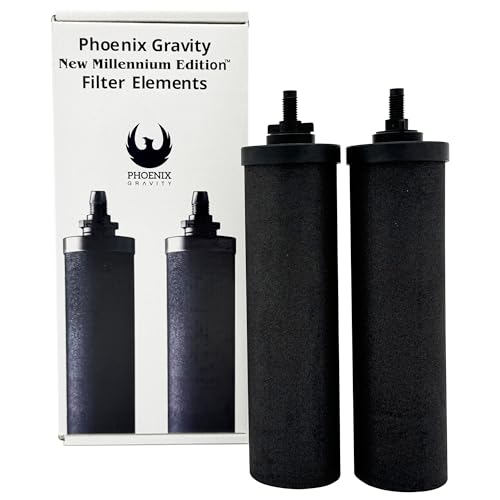
| NSF/ANSI 42 | Yes, listed for chlorine reduction | Phoenix Gravity New Millennium Edition elements are listed by Berkey as NSF/ANSI 42 certified |
| NSF/ANSI 372 | Yes, listed for lead-free materials | Phoenix Gravity New Millennium Edition elements are also listed as NSF/ANSI/CAN 372 |
| Third-party testing | Independent laboratory testing is listed | Black Berkey elements are described as tested by accredited third-party labs |
⭐ Phoenix – 10/10 | Berkey – 9/10
Phoenix’s current product page makes its certification structure easy to see.
Filter Life: How Often Do You Replace It?
Filter life affects both cost and effort. This is where the long-game math matters.
| Feature | Product 1 | Product 2 |
|---|---|---|
| Main filter life | Phoenix lists carbon elements for up to six months | Black Berkey elements are recommended for replacement at 3,000 gallons each |
| Two-element set | Depends on filter configuration and use | 6,000 gallons stated per two-element set |
| Cleaning | Follow Phoenix filter care instructions | Black Berkey elements can be re-cleaned during their life |
⭐ Phoenix – 8/10 | Berkey – 10/10
Berkey has a much more explicit gallon-based replacement figure for Black Berkey elements.
Setup: Which Is Easier?
Both systems are made for people who do not want a plumber in the kitchen.
| Feature | Product 1 | Product 2 |
|---|---|---|
| Electricity | Not required | Not required |
| Plumbing | Not required | Not required |
| Countertop use | Yes | Yes |
| Portable use | Suitable for many portable settings | Go and Travel models support portable use |
⭐ Phoenix – 10/10 | Berkey – 10/10
It is a draw: both use the simple gravity approach and avoid permanent installation.
Maintenance: What Does Ownership Take?
Gravity filters are simple, but simple does not mean maintenance-free.
| Feature | Product 1 | Product 2 |
|---|---|---|
| Routine cleaning | Required according to care instructions | Recommended regularly |
| Element care | Follow the filter-specific care guide | Black Berkey elements can be scrubbed and re-primed |
| Moving the system | Use normal care when handling filter elements | Remove Black Berkey elements before transport |
⭐ Phoenix – 9/10 | Berkey – 9/10
Both are simple to maintain, but neither should be treated as a set-and-forget appliance.
Final Verdict: Which Should You Buy?
The phoenix water filter vs berkey choice comes down to priorities. Phoenix stands out for its current NSF/ANSI 42 and 372 certifications, stainless steel build, simple setup, and optional fluoride and arsenic reduction stage. Berkey stands out for its wide range of system sizes, larger capacity choices, higher published flow on the Big Berkey, and long stated Black Berkey element life.
For a smaller U.S. household that values clear certification details and a simple setup, Phoenix is a strong fit. For a larger household or someone focused on storage and long filter life, Berkey may fit the routine better. In either case, match the exact filter to your water source and check the current test data before buying.